Without Blood 2026 Ending Explained: The Deeper Meaning of Nina and Tito’s Final Choice
I’ve sat through more “war movie” endings than I can count — the kind where the camera lingers on a burning village, someone screams into the rain, and the credits roll over a swelling string section. So when I walked into Without Blood expecting some version of that, I was almost annoyed by how quiet it stayed. No explosions. No last-minute rescue. Just two people, a table, and forty years of unfinished business. And somehow that’s exactly why the ending has stuck with me longer than half the “epic” war dramas I grew up on.
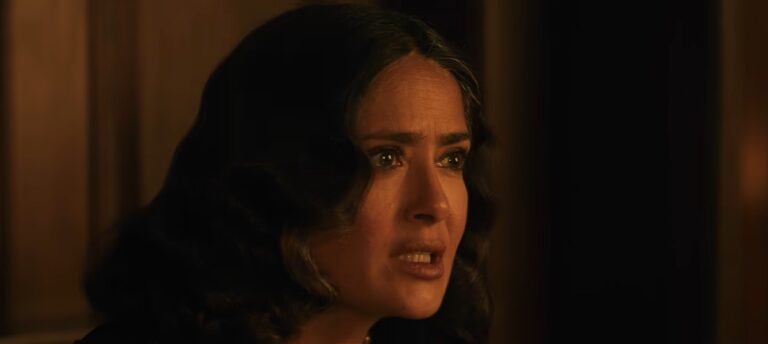
Angelina Jolie’s adaptation of Alessandro Baricco’s slim, brutal little novella isn’t interested in giving you a war movie at all. It’s interested in what happens after — decades after — when the guns are long gone but the damage is still walking around wearing normal clothes, running a newsstand, ordering tea. Salma Hayek Pinault and Demián Bichir carry almost the entire back half of the film in a single café conversation, and if that sounds slow on paper, on screen it plays more like a standoff than a chat.
Here’s the breakdown of what actually happens at the end, why Nina makes the choice she makes, and why I think the internet keeps arguing about it for the wrong reasons.
Quick Refresher: The Cellar Scene That Explains Everything
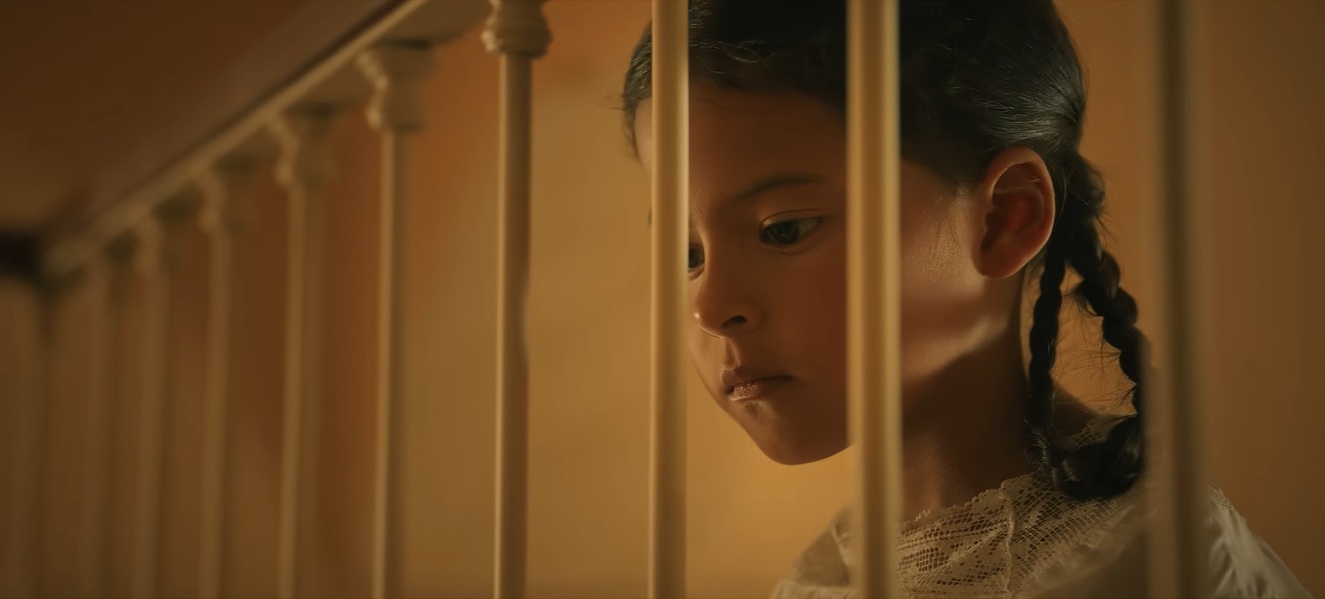
Before the café, before the tea, before any of the adult drama — there’s a farmhouse.
A group of soldiers show up to execute a doctor they blame for wartime deaths, including their commander’s brother. It’s ugly and fast. The doctor and his son are killed. His young daughter, Nina, squeezes into a hiding spot under the floorboards and holds her breath.
One of the soldiers — young, unsure of himself, clearly not built for this line of work — finds her. This is Tito. He has a split second to decide whether she lives or dies, and instead of raising a gun or calling his commander over, he just… closes the hatch. Says nothing. Walks away.
That’s it. That’s the whole hinge the entire film swings on. One choice, made in maybe four seconds, that defines two entire lives.
The Café Scene Isn’t a Standoff — It’s an Interrogation
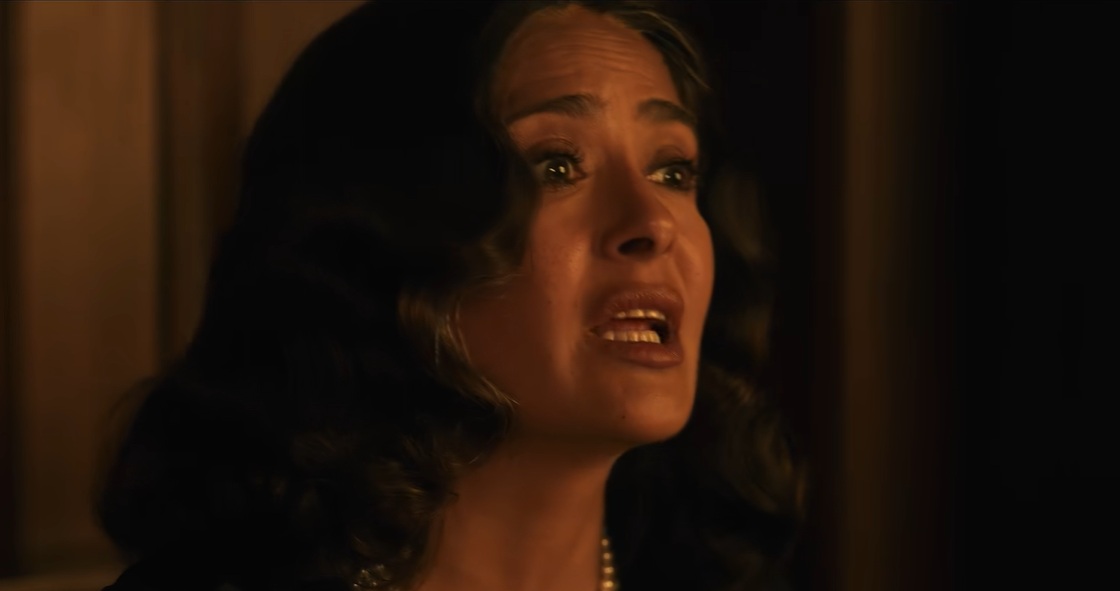
Cut to decades later. Nina, now hardened and unreadable, tracks Tito down to the small kiosk where he’s spent years trying to disappear into an ordinary, unremarkable existence. She invites him for tea at a nearby café, and from the second they sit down, you can feel the tension of a gun that might come out at any moment — because she does have one, tucked in her bag.
But what actually unfolds isn’t a shootout waiting to happen. It’s something closer to two unreliable narrators comparing notes on the same tragedy:
- Nina’s version of her life after the farmhouse is a spiral — passed between predatory men, married off as a teenager, eventually locked away and declared unfit by her own family so they could take her inheritance.
- Tito’s version, pieced together from wartime rumor, paints some of those same events differently — suggesting the man she married actually cared for her, tried to shield her, rather than exploit her.
Neither of them is necessarily lying. That’s the uncomfortable part. Memory after trauma doesn’t work like a court transcript — it works like a wound that keeps reshaping itself depending on who’s touching it. Jolie leans hard into that idea, and honestly, it’s the smartest choice in the whole script.
So What Actually Happens at the End?
This is the part people can’t stop arguing about, so let’s just lay it out plainly.
| Moment | What You’d Expect | What Actually Happens |
|---|---|---|
| Nina reveals she knows Tito’s role in her family’s death | Immediate confrontation or violence | A slow, controlled conversation instead |
| The gun in Nina’s bag | Chekhov’s gun goes off | It never gets used |
| Tito admits his guilt | Redemption arc / forgiveness speech | He simply admits he’s spent his life waiting for her to come back and kill him |
| The final scene | Nina walks away, or shoots him | She takes him to a hotel room for the night instead |
That last beat is the one that splits audiences. Nina doesn’t shoot Tito. She doesn’t forgive him out loud, either. She invites him somewhere private, and the film ends on that unresolved, deeply strange note — no farewell speech, no clean moral lesson, just the two of them together in a room, and then the camera pulls back and leaves you there.
The detail that actually got me, though, isn’t the hotel room itself — it’s what happens inside it. As they lie together, Tito curls his body into the exact same cramped, defensive posture Nina used as a child hiding in that cellar. It’s such a small physical choice, but it reframes the entire film in about three seconds.
Why the Posture Mirror Matters More Than the Gun
That single image — Tito folding into Nina’s childhood hiding position — is doing more storytelling than the entire dialogue-heavy second act combined. It suggests something the script never says outright: Tito never actually left that cellar either.
He survived the war physically. He built a quiet little life selling newspapers and lottery tickets. But emotionally, he’s been crouched in the dark the whole time, waiting for the debt to come due. Nina spent forty years as the visible casualty of that day. Tito spent forty years as the invisible one. By the end, the line between “the person who was harmed” and “the person who caused harm” gets blurry in a way that’s genuinely uncomfortable to sit with.
Why Doesn’t Nina Just Kill Him?
This is the question every forum thread keeps circling back to, and I think people overcomplicate it. Killing Tito wouldn’t be justice — it would just be one more act of violence layered onto a pile that’s already suffocating both of them. It would prove that the men who murdered her family were right about how the world works: that force settles everything.
Nina choosing not to pull the trigger isn’t a warm, feel-good act of forgiveness. It’s colder than that, and more deliberate. A few reasons the choice actually makes sense once you sit with it:
- Revenge wouldn’t undo anything. Her parents stay dead either way.
- It would trap her permanently in the same cycle of violence that ruined her childhood.
- It reclaims control. For the first time in the story, Nina decides the ending — not the men with the guns, not fate, not Tito.
That’s the whole thesis of the film, really: violence doesn’t get the last word just because it got the first one.
The Nameless War Is the Point, Not a Cop-Out
One thing worth mentioning for anyone who found the setting frustratingly vague — the war in Without Blood is never named. No flags, no clear nationality, no timestamp beyond “sometime in the past century.” It’s filmed across sun-bleached Italian countryside with an entirely Latin American cast speaking English, and that dislocation is deliberate.
Jolie isn’t trying to make a movie about a specific conflict. She’s making a movie about what conflict does to people, regardless of the uniform or the decade. The farmhouse could be Mexico in 1915 or a nameless border town today — the psychological wreckage plays out identically.
Neagley Season 1 Episode Count, Release Schedule, and Prime Video Streaming Guide
Final Thought
Without Blood isn’t going to satisfy anyone looking for a clean revenge thriller, and honestly, I think that’s the whole point. It ends the way real trauma actually resolves — messily, without a tidy bow, without a villain getting what they “deserve” in the way genre convention usually promises. Nina and Tito don’t get healed. They just, for one night, stop bleeding in the same direction. Whether that counts as peace is left entirely up to you.