Why Millions Are Searching for Jimothy The Dog on Instagram and TikTok Today: The Viral Trend Explained
There is something revealing about the stories that capture the internet’s attention. While political leaders argue over borders, governments struggle to communicate with frustrated citizens, and breaking news competes for every available second of our attention, millions of people can suddenly become fascinated by an animal with an unusual body shape and a name that sounds almost deliberately invented.
That is the strange appeal of Jimothy the Dog, the name circulating across TikTok, Instagram Reels, and YouTube Shorts in October 2026. At first glance, this looks like another harmless animal meme destined to disappear within a few days. Look a little closer, however, and the phenomenon says something interesting about modern internet culture: how attention moves, how online communities manufacture shared experiences, and why seemingly insignificant stories can travel further than events with genuine political consequences.
The curious part is that Jimothy did not originally become famous as a dog. The story begins with a raccoon, develops through a series of canine lookalikes, and eventually turns into a social media trend that is considerably larger than its original subject.
From a Seattle Raccoon to an Internet Celebrity
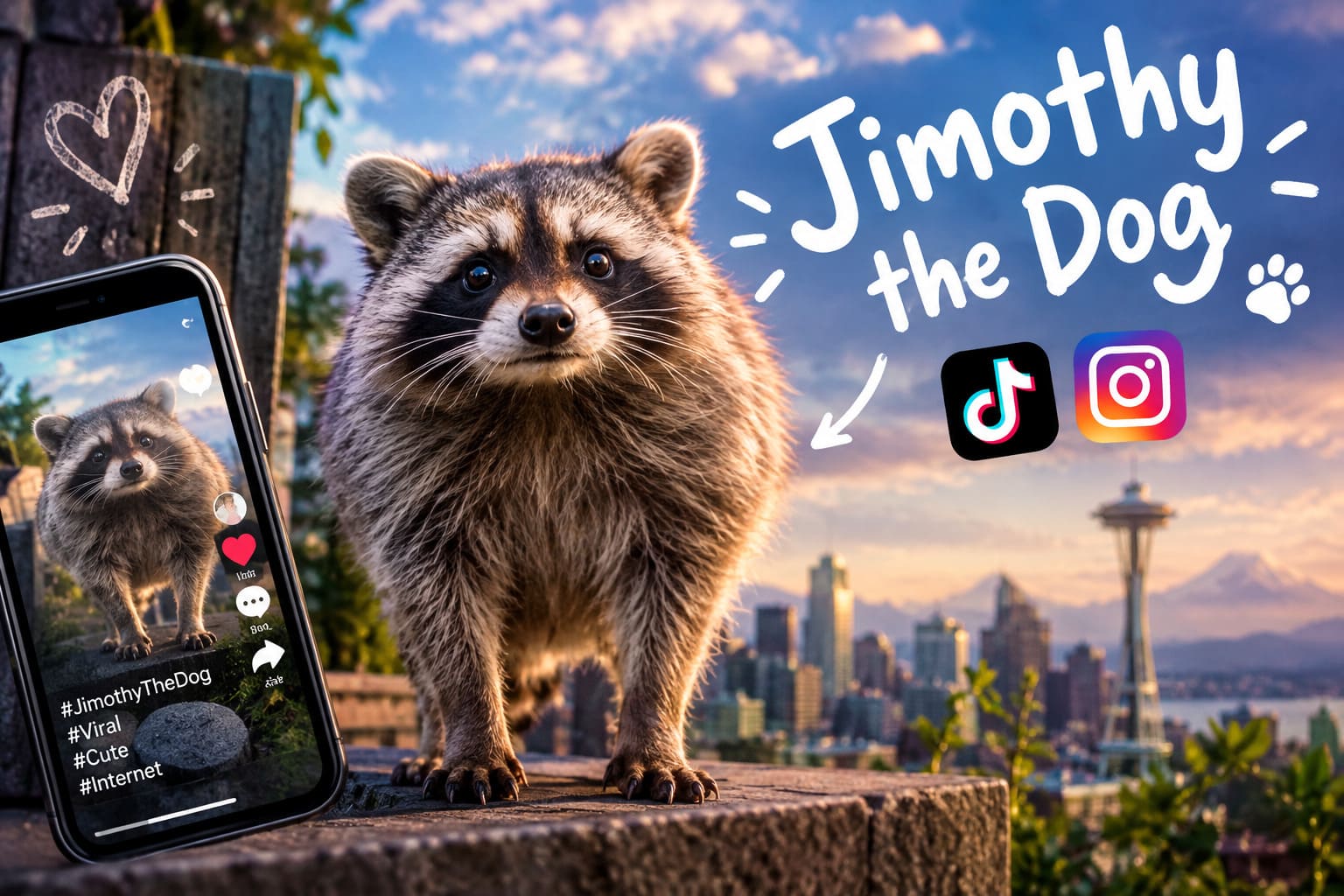
According to the story circulating online, the original Jimothy emerged in July 2026 in Seattle’s Ballard neighborhood. He was a wild raccoon whose unusually compact, rounded appearance immediately caught people’s attention. Videos featuring the animal spread rapidly, turning a creature that would ordinarily have remained an obscure neighborhood curiosity into a recognizable internet personality.
The explanation offered for Jimothy’s distinctive appearance was equally fascinating. Online discussions pointed toward short spine syndrome, an exceptionally rare congenital condition associated with a shortened spinal column and a compressed neck and torso.
Animals affected by this condition can have proportions that look unusual compared with those of their species. Their bodies may appear remarkably compact, while their limbs seem disproportionately long. The result is an appearance that some viewers describe as spherical or almost cartoonish.
Jimothy’s story also acquired an emotional dimension through accounts of his mother, reportedly named Jimberly, and his survival in the wild. The combination of unusual anatomy, a memorable name, and a narrative about family and survival gave audiences more than a funny clip to share.
It gave them a character.
That distinction matters. Internet audiences rarely become attached to an animal solely because it looks unusual. They respond to the story built around it. A name makes an animal memorable; a recognizable personality makes it shareable; and a narrative gives people a reason to return.
Jimothy eventually inspired fan art, merchandise, jokes, and the playful expression “Hot Jimothy Summer.” The raccoon became a small but recognizable example of how online fame can transform an ordinary wildlife encounter into a collective cultural event.
THE NEW JIMOTHY? A RARE ALBINO PORCUPINE IS GOING VIRAL ACROSS MAJOR US NEWS CHANNELS
A rare white porcupine spotted crossing a road in Vermont is now blowing up everywhere
NBC Boston, NBC Chicago, NBC Dallas, NBC San Diego and WCAX are all spreading the footage
But here’s the interesting part
Almost 6 months ago, same albino porcupine went viral on Reddit, where someone gave it the nickname POLARPINE
Now people are calling it POLARPINE again under today’s viral TikToks, while a Facebook reel with 10K+ likes has people comparing it to JIMOTHY
The same rare animal meme is coming back 6 months later, except this time major news channels are pushing it nationwide
ORIGINAL NAME PROOFS:
Reddit — Polarpine nickname 6 months ago:
https://t.co/0lNHjJ7P1lNBC Chicago TikTok — Polarpine nickname again:
https://t.co/8tonxnH6aUFacebook — 10K+ likes, next Jimothy comparison:
https://t.co/p96XDZJZxhMAJOR NEWS COVERAGE:
NBC10 Boston:
https://t.co/Hu0SZ6Jpl0NBC Chicago:
https://t.co/3w81bGJ0pQNBC Dallas-Fort Worth:
https://t.co/QaUNrICtbbNBC 7 San Diego:
https://t.co/nj62qHpmZgPolarpine — The Albino Porcupine
— SIZEY (@Sizeyon) October 14, 2026
Why Is Everyone Searching for Jimothy the Dog?
The transition from raccoon to dog was almost inevitable.
Once Jimothy became recognizable, social media users began looking for animals that resembled him. Some were genuinely unusual. Others were perfectly ordinary pets whose fluffy coats, compact bodies, or awkward sitting positions made them suitable candidates for comparison.
The phrase “Jimothy the Dog” became a convenient label for this expanding collection of lookalikes.
One of the videos associated with the trend reportedly came from an account called PacificTees, using the caption “I FOUND THE DOG VERSION OF JIMOTHY.” The clip featured a fluffy dog described as a Pomsky and Nova Scotia Duck Tolling Retriever mix, whose appearance reminded viewers of the famous raccoon.
The appeal was immediate. People did not need to know anything about animal genetics, the original location, or the history of the meme. They only needed to recognize the resemblance.
This is how a successful internet trend often develops:
- Recognition: Viewers encounter an unusual animal and remember its appearance.
- Imitation: Pet owners begin posting animals that share similar characteristics.
- Competition: Creators attempt to find a dog that resembles the original more closely than previous examples.
- Expansion: The name becomes a hashtag, a joke, and a searchable category of its own.
Each stage creates fresh material for the next one. A viewer who discovers the trend through one video may start searching for other examples, posting their own pet, or arguing in the comments about which animal deserves the title.
The original raccoon is no longer the entire story. The community surrounding him becomes the story.
Short Spine Syndrome: The Serious Biology Behind the Funny Videos
The medical aspect of the Jimothy phenomenon deserves more attention than it usually receives in a fast-moving social media feed.
Short spine syndrome is a rare congenital skeletal condition reported in animals, including dogs. It can affect the shape and proportions of the body, producing a shortened spine and an unusual overall appearance.
However, an animal looking like Jimothy does not mean it has short spine syndrome.
A fluffy coat, a naturally compact build, a particular posture, or the camera angle can make a healthy dog appear remarkably similar to the original raccoon. Establishing a genuine congenital condition requires a veterinary assessment rather than a comparison with a viral photograph.
That distinction is important because social media tends to collapse several different things into a single visual category. A dog with a diagnosed congenital condition, a healthy dog with an unusual body shape, and a heavily groomed pet can all become part of the same meme.
Their appearances might invite the same joke, but their circumstances are not necessarily comparable.
Responsible coverage should also avoid assuming that every affected animal is comfortable or free from medical complications. An individual animal’s health depends on its specific condition and veterinary evaluation. A short viral video cannot establish whether a dog is pain-free or whether its anatomy affects its long-term well-being.
There is nothing wrong with enjoying these videos. The problem begins when entertainment is mistaken for medical evidence.
The Jimothy Cinematic Universe: How a Meme Becomes a Community
The trend has also developed its own vocabulary. Variations such as “Himothy,” “Jumithy,” and “Denthy” appear in the playful language associated with the phenomenon.
These names might seem meaningless to anyone encountering them for the first time. For people already following the trend, however, they function as a form of shorthand. They communicate familiarity with the joke and invite others to participate.
This is one reason animal memes can develop unusually durable online communities. The subject is accessible, the stakes are relatively low, and participation requires almost no specialist knowledge.
A user does not need to understand international relations, financial markets, or the history of a political conflict to appreciate a dog that resembles a raccoon. They simply need a few seconds and a willingness to laugh.
The contrast with political news is striking. Public affairs often demand sustained attention, historical context, and an uncomfortable willingness to confront competing interpretations. Viral animal content offers the opposite experience: immediate recognition, an emotional response, and a simple opportunity to share that response with other people.
As someone approaching internet culture through the lens of global news and public opinion, I find that contrast more interesting than the meme itself.
The internet does not stop caring about serious events when an animal goes viral. But attention is finite, and platforms reward content that produces quick, measurable reactions. A funny animal clip can achieve that result far more easily than a complicated explanation of a diplomatic crisis.
What Is Universal-Modder? The Viral AI Tool Blending Minecraft, FNAF, and Cyberpunk
Why the Trend Is Spreading Across the United States
Several forces may explain the reported surge in searches for Jimothy the Dog during October 2026.
| Factor | Why It Matters |
|---|---|
| Visual Recognition | Viewers can understand the resemblance without reading a long explanation. |
| Emotional Appeal | Animals encourage affection, curiosity, and low-conflict participation. |
| Algorithmic Recommendations | Watching, sharing, and commenting can expose the trend to additional audiences. |
| User-Generated Content | Every new lookalike gives creators another opportunity to participate. |
| Search Curiosity | People who encounter the name repeatedly may search for its origin. |
The last point is particularly important. Search interest does not necessarily begin with an audience deliberately looking for a particular animal. It can begin with confusion.
Someone sees the phrase “Jimothy the Dog” in a comment. Another person encounters a video claiming to have found the raccoon’s canine equivalent. A third sees a reference without understanding the original joke.
Eventually, all three may search for the same phrase.
The result is a feedback loop: social media generates curiosity, search engines capture that curiosity, and the apparent popularity of the search term can encourage further coverage and discussion.
There is one qualification worth making. Claims that millions of people are searching for Jimothy the Dog, or that the phrase has reached a specific traffic peak today, require reliable search-volume or platform data. Viral visibility alone cannot establish the exact number of people involved. The same applies to claims about individual videos reaching particular view counts.
The broader mechanism is well understood, but the precise scale of this particular trend should not be confused with independently verified statistics.
Is Jimothy the Dog Really a New Cultural Phenomenon?
Not entirely. The internet has a long history of turning unusual animals into celebrities, then building entire waves of imitation around them. What makes the Jimothy story distinctive is the relationship between the original animal and the new wave of content.
The raccoon provides the reference point. The dogs provide endless variations. The audience supplies the jokes, comparisons, and increasingly elaborate mythology.
It is a remarkably efficient format for short-form platforms because it can reproduce itself without requiring new developments in the original story.
A creator can post a new lookalike tomorrow. Someone else can dispute the resemblance. Another user can introduce a different nickname. None of these developments needs to change the underlying story, yet each can generate fresh engagement.
This is also why it would be premature to declare Jimothy the permanent king of social media. Viral popularity is volatile. Today’s favorite animal can be replaced by an unrelated celebrity, a sporting moment, a political controversy, or a new meme within hours.
Still, a trend does not need to last forever to reveal something about the culture that produced it.
Jimothy’s appeal rests on a combination of novelty, affection, repetition, and participation. People are not simply watching an animal. They are helping to extend a story that other people already recognize.
What Happens Next for Jimothy the Dog?
The most likely future for the trend is a gradual shift from discovery to repetition. Early audiences want to know who Jimothy is and why the animal looks so unusual. Later audiences are more interested in finding the next lookalike, creating a joke, or testing whether their own pets fit the comparison.
Eventually, the name may survive even after the original story fades from mainstream attention. That is how internet shorthand works: people continue using a reference because they recognize it, even when they no longer remember every detail behind it.
For pet owners, the trend offers an opportunity to share amusing photographs and videos. For animal lovers, it can introduce a wider audience to an uncommon biological condition. For social media platforms, it supplies exactly the kind of repeatable content that encourages people to keep scrolling.
The challenge is maintaining the distinction between a harmless joke and an unsupported claim about an animal’s health.
And for everyone else, Jimothy is a reminder that the modern internet does not always need a grand narrative. Sometimes, it needs only a strange-looking raccoon, a memorable name, and a dog that happens to resemble him.
Jimothy the Dog has become a useful example of how viral internet trends evolve: one unusual animal attracts attention, lookalikes turn that attention into a participatory game, and algorithms help carry the joke to people who have never encountered the original story.
Whether the trend lasts another week or disappears tomorrow, its underlying appeal is easy to understand. In a world saturated with urgent headlines and arguments that rarely seem to end, a few seconds of uncomplicated animal comedy can feel like a welcome break.
The internet will move on eventually. For now, Jimothy and his canine imitators have managed to turn a peculiar wildlife story into a shared social media obsession.