Why Did the Stock Market Drop Today? Hot September CPI Inflation Data Spooks Investors
There are days when the stock market falls because investors have discovered something genuinely new. And then there are days when a familiar problem returns with enough force to destroy weeks of optimism. Wednesday, October 14, 2026, looked very much like the second kind.
U.S. stocks came under heavy selling pressure after September’s inflation report delivered an uncomfortable message to investors: the fight against rising prices is not over. The Nasdaq Composite and S&P 500 led the retreat, while the Dow Jones Industrial Average also finished lower. Suddenly, the prospect of easier monetary policy looked considerably less certain.
From my perspective as an international political observer, this is about more than a disappointing economic statistic. Inflation has become one of the most politically sensitive forces shaping Western economies, influencing everything from household budgets and election debates to government borrowing costs and international energy policy. When consumer prices refuse to cool, the consequences rarely remain confined to the trading floor.
The immediate fear on Wall Street is straightforward. The Federal Reserve may have to keep interest rates elevated for longer than investors expected, potentially considering another increase if inflation proves stubborn enough. That would complicate the outlook for technology companies, pressure consumers already dealing with expensive credit, and leave policymakers with fewer comfortable options.

September CPI Report: The Numbers That Shook Wall Street
The latest Consumer Price Index report provided the catalyst for Wednesday’s sell-off. According to the figures outlined in the report, inflation accelerated beyond economists’ expectations, challenging the assumption that price pressures were moving steadily toward the Federal Reserve’s 2% target.
Here are the key figures investors were watching:
| Inflation Indicator | September Reading | Market Expectation |
|---|---|---|
| Headline CPI, year over year | 3.7% | 3.6% |
| Headline CPI, month over month | 0.6% | — |
| Core CPI, month over month | 0.3% | 0.2% |
| Core CPI, year over year | 2.6% | 2.5% |
Figures reflect the supplied report; the original figures and official release should be independently verified before publication.
The headline numbers were troubling enough, but the underlying inflation picture was arguably more important. Core CPI excludes food and energy prices, helping economists assess whether inflationary pressure is spreading beyond the most volatile categories.
A monthly core increase of 0.3%, above the anticipated 0.2%, offered little reassurance. Even when energy prices are stripped out, the broader economy can continue generating inflation through housing, services, labor costs, and persistent consumer demand.
For investors, the distinction matters. A temporary jump in gasoline prices might be manageable. Inflation that remains embedded across multiple sectors is a much harder problem.
The real concern is that inflation could remain above the Fed’s comfort zone long enough to prevent meaningful monetary easing. Markets had been looking for a path toward lower borrowing costs. The September figures made that path look considerably narrower.
US inflation came in hotter than expected.
September CPI rose 3.7% year over year, above the 3.6% forecast, and 0.6% month over month.
Stock futures are slipping:
S&P 500: -0.2%
Nasdaq-100: -0.5%
Dow: -62 points (-0.1%)— Invezz (@InvezzPortal) October 14, 2026
Why the Federal Reserve Suddenly Matters Even More
Financial markets are forward-looking. They do not simply react to what happened last month; they constantly attempt to price what policymakers, businesses, and consumers will do next.
Before the inflation figures arrived, some investors were positioned for a relatively favorable scenario: inflation would gradually decline, the Federal Reserve would avoid additional tightening, and economic growth would remain strong enough to support corporate earnings.
That combination would be close to an ideal outcome for equities. Unfortunately, it depends on several things going right at once.
The latest CPI surprise threatens that assumption. According to the supplied report, estimates of the probability of a quarter-point rate increase at the October 27–28 Federal Open Market Committee meeting rose sharply, with different trackers putting the odds between approximately 42% and 60%.
Those figures should be treated as market-implied estimates rather than a prediction of what the Fed will actually do. Still, the change in expectations helps explain why investors reacted so aggressively.
Higher interest rates have consequences that reach well beyond financial institutions.
- Corporate borrowing becomes more expensive. Companies may postpone expansion, reduce hiring, or reconsider major investments.
- Consumers face tighter financial conditions. Mortgages, credit cards, and other forms of borrowing can become less affordable.
- Equity valuations come under pressure. Future earnings become less attractive when investors can earn better returns from relatively safe government debt.
The Treasury market is particularly important here. The two-year U.S. Treasury yield tends to respond closely to expectations about Federal Reserve policy. When traders anticipate higher rates, yields can rise quickly, changing the relative appeal of stocks and bonds.
There is an uncomfortable political dimension to this process. Central bankers may need to maintain restrictive policy even when households and businesses are already frustrated by the cost of living. A rate increase can help restrain demand, but it cannot directly resolve an oil supply disruption or instantly expand housing supply.
That is the difficult reality facing policymakers: the tools available to fight inflation are powerful, but they are not designed to solve every cause of inflation.
Technology and AI Stocks Take the Hardest Hit
Technology stocks were among the most vulnerable areas of the market as investors reassessed the cost of capital and the value of future growth.
The pressure on artificial intelligence companies is especially interesting. For much of the recent market cycle, AI investment has been treated as a powerful reason to pay premium valuations for semiconductor manufacturers, cloud providers, and data-center operators.
But enthusiasm does not eliminate financial constraints.
Building large-scale AI infrastructure requires enormous spending on chips, servers, electricity, cooling systems, and data-center capacity. Companies must justify those expenditures with future revenue, and higher interest rates make that calculation more demanding.
This does not mean the AI investment boom is necessarily ending. It does mean investors may become less forgiving of businesses that promise extraordinary growth without demonstrating how quickly that growth can translate into sustainable profits.
In my view, this is where Wednesday’s market reaction could have a longer-lasting effect. A correction driven by inflation can expose weaknesses that were already present beneath a rising market.
Investors may begin asking harder questions:
- Are AI infrastructure investments generating sufficient returns?
- Can technology companies maintain margins if financing and operating costs rise?
- Have stock valuations become too dependent on an uninterrupted decline in interest rates?
Those questions are particularly relevant for semiconductor companies and smaller technology firms that need substantial capital to compete.
The broader lesson is simple: a promising technological revolution does not make a company immune to monetary policy.
Bank of America Adds to Financial Sector Anxiety
Financial stocks also faced pressure, with Bank of America reportedly falling after announcing a decline in third-quarter net profit amid higher regulatory expenses and changing deposit dynamics.
The timing made the news particularly uncomfortable. Investors were already reassessing the interest-rate outlook, and weaker bank earnings offered another reason to question the strength of the corporate environment.
The relationship between higher rates and bank profitability is not straightforward. Some banks can benefit from higher lending rates, but they may also have to pay more to retain deposits. Meanwhile, regulatory expenses, credit quality, and the demand for loans can affect earnings in ways that higher rates do not necessarily offset.
For the financial sector, the key question is whether elevated borrowing costs are improving interest income or gradually weakening the businesses and households that banks depend on.
That distinction will become increasingly important as more third-quarter earnings reports arrive.
If other major institutions report similar pressure on profitability, investors may interpret the problem as broader than a single company’s performance. If earnings remain resilient, Wednesday’s reaction could eventually look excessive.
Oil Prices, Middle East Tensions, and the Global Inflation Problem
The inflation story becomes more complicated when viewed beyond the United States.
Ongoing geopolitical tensions in the Middle East have kept energy markets sensitive to supply risks. Oil prices can react sharply to threats against shipping routes, disruptions to production, or fears that a regional conflict could spread.
Higher energy costs affect far more than the price displayed at a gasoline station. They can increase transportation expenses, raise the cost of manufacturing, put pressure on food distribution, and reduce the disposable income available to households.
This creates a difficult situation for central banks. Monetary tightening can cool domestic demand, but it cannot directly remove geopolitical risk from the global oil market.
The political consequences can be significant. Governments facing persistently high living costs often encounter pressure to provide subsidies, reduce taxes, or introduce other forms of relief. Those measures may help households in the short term, but they can also increase fiscal burdens or weaken the incentive to reduce energy consumption.
There is a wider international concern, too. Higher U.S. interest rates can attract capital toward dollar-denominated assets, placing pressure on some emerging-market currencies and increasing the cost of servicing dollar debt.
For countries that import substantial amounts of energy, the combination of expensive oil and a stronger dollar can become particularly painful.
This is why the latest U.S. inflation figures matter to investors far beyond Wall Street. The Federal Reserve’s decisions can influence financing conditions across the global economy, including in countries that have little control over American monetary policy.
Gold Falls as Treasury Yields Become More Attractive
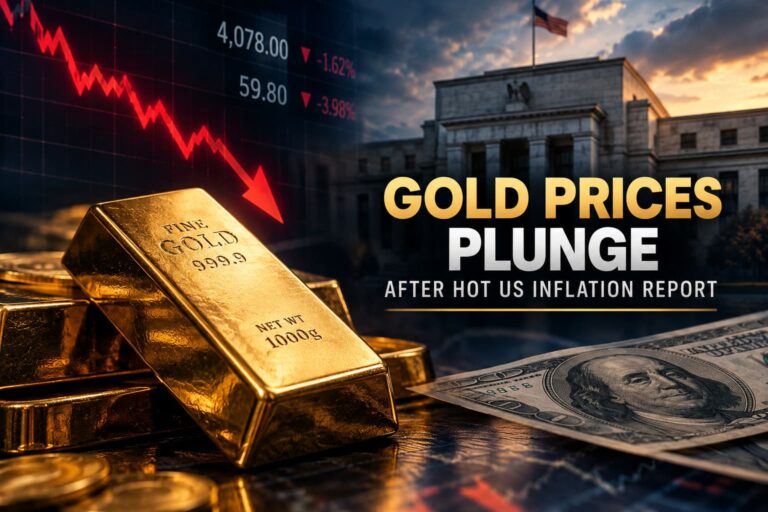
Gold also reportedly declined sharply during Wednesday’s trading session, falling by nearly 2% and moving below $4,100 an ounce.
At first glance, the reaction might seem counterintuitive. Gold is often described as a safe-haven asset, so why would it fall during a day of market anxiety?
The answer lies in the relationship between gold, interest rates, and investor expectations.
Gold does not pay interest. When Treasury yields rise, investors have a stronger financial incentive to hold interest-bearing government securities instead. Higher real yields can therefore weigh on gold, even when uncertainty is increasing elsewhere.
The dollar can add another layer of pressure. Because gold is priced internationally in dollars, a stronger U.S. currency can make the metal more expensive for buyers using other currencies.
There is also a question of positioning. If investors have already accumulated large gold holdings, a sudden shift in interest-rate expectations can encourage profit-taking.
None of this means gold has lost its role as a potential hedge against financial or geopolitical instability. It does demonstrate that safe-haven assets do not always move in the direction investors expect, particularly when monetary policy changes the opportunity cost of holding them.
What Retail Investors Are Saying About the Sell-Off
The reaction among retail traders, financial commentators, and online investing communities reflects a familiar pattern: optimism gives way to caution when a market that appeared comfortable suddenly encounters an unwelcome economic surprise.
Discussions across trading forums have focused on the sustainability of AI spending, the possibility of additional Federal Reserve tightening, and whether recent stock valuations left too little room for disappointment.
The so-called October Effect has also returned to the conversation. October has a notorious place in market history because of major crashes in 1929 and 1987, as well as the severe financial turmoil of 2008.
However, there is an important distinction between historical coincidence and a reliable forecasting tool. October is not automatically a bad month for stocks, and past crashes do not establish that another one is imminent.
I would pay closer attention to the fundamentals than to the calendar. Inflation, bond yields, corporate earnings, liquidity, and investor positioning provide more useful information than the month in which a correction occurs.
The more meaningful warning sign would be a combination of deteriorating earnings expectations, persistently rising yields, and weakening economic activity. That would suggest the market is dealing with something more substantial than a single disappointing CPI release.
What Happens Next? Three Scenarios for Wall Street
The next phase of the market reaction will depend on whether September’s inflation surprise proves temporary or reflects a more persistent problem.
| Scenario | What Investors Would See | Potential Market Impact |
|---|---|---|
| Inflation cools | Subsequent data show slower price growth | Stocks could recover as rate fears ease |
| Inflation stays elevated | Price pressures remain persistent | Volatility and higher-for-longer concerns continue |
| Inflation rises further | Additional data show renewed acceleration | Rate expectations could tighten further, pressuring equities |
These are possible outcomes, not forecasts or guarantees.
Corporate earnings will be just as important as economic data. Strong results and credible forward guidance could help stabilize the market, particularly if companies demonstrate that they can protect margins despite higher financing costs.
Weak earnings combined with stubborn inflation would be a more troubling combination. It could revive fears of stagflation, in which economic growth slows while inflation remains uncomfortably high.
Investors should also watch employment figures and retail sales. A cooling labor market and softer consumer spending could eventually reduce inflationary pressure, although an abrupt slowdown would create its own concerns for corporate profits.
The Federal Reserve’s October 27–28 meeting will be another important point of attention, but the decision should not be viewed in isolation. Policymakers will have to weigh the complete economic picture rather than react mechanically to one inflation report.
Scrubs Season 2 Revival (2026): Episode Count, Release Schedule, and How to Watch in US & EU
One Bad CPI Report Can Change the Market Narrative
Wednesday’s sell-off illustrates how quickly investor confidence can change when economic data challenge a widely held assumption.
The market had been looking for evidence that inflation was moving in the right direction. Instead, the September CPI figures described in the report suggested that price pressures remain persistent, raising doubts about how soon the Federal Reserve could comfortably ease monetary policy.
Technology and AI stocks face questions about valuations and capital spending. Banks must navigate an uncertain earnings environment. Gold has to compete with rising bond yields, while geopolitical tensions continue to complicate the global energy outlook.
Still, it would be premature to treat one difficult trading session as proof that a prolonged bear market has begun. Markets can overreact to fresh information, particularly when investors have built positions around a favorable economic narrative.
The bigger issue is what comes next.
If inflation begins to cool and corporate earnings remain healthy, the current decline could eventually prove to be a painful but temporary repricing. If price pressures persist while economic growth weakens, Wall Street may have to adjust to a much less forgiving environment.
My view is that investors should pay less attention to dramatic predictions about an imminent crash and more attention to the interaction between inflation, bond yields, and corporate profits. Those three forces will tell us far more about the market’s direction than any single day’s losses.
For now, the message from Wall Street is unmistakable: the path toward lower inflation and cheaper borrowing remains uncertain, and investors are no longer willing to assume that the Federal Reserve will make the journey easy.