Who Is the New White House Press Secretary After Katie Zacharia’s Ousting?
The White House has never been short of drama, but the sudden collapse of Katie Zacharia’s brief tenure as press secretary has created a problem that goes well beyond one disastrous press conference. In a political environment where every public appearance can become a viral clip within minutes, the administration has been reminded of an uncomfortable truth: controlling the message is considerably harder when the messenger becomes the story.
As of mid-October 2026, President Donald Trump has yet to announce a permanent replacement for Zacharia. Instead, he has indicated that he is in no rush to fill the position, leaving the administration’s communications operation to navigate an unusually awkward transition during an important stretch of the political calendar.
Two names have emerged as potential candidates for the high-profile position: Scott Jennings, the Republican strategist and CNN commentator, and Margo Martin, a trusted member of Trump’s inner circle. Neither should be treated as a confirmed appointment. For now, the White House appears to be weighing the advantages of bringing in an experienced media personality against the appeal of promoting someone who already understands the president’s preferred style of communication.
The bigger question is whether this episode will lead to a genuine change in the administration’s approach to press relations or simply produce another familiar face behind the briefing-room podium.
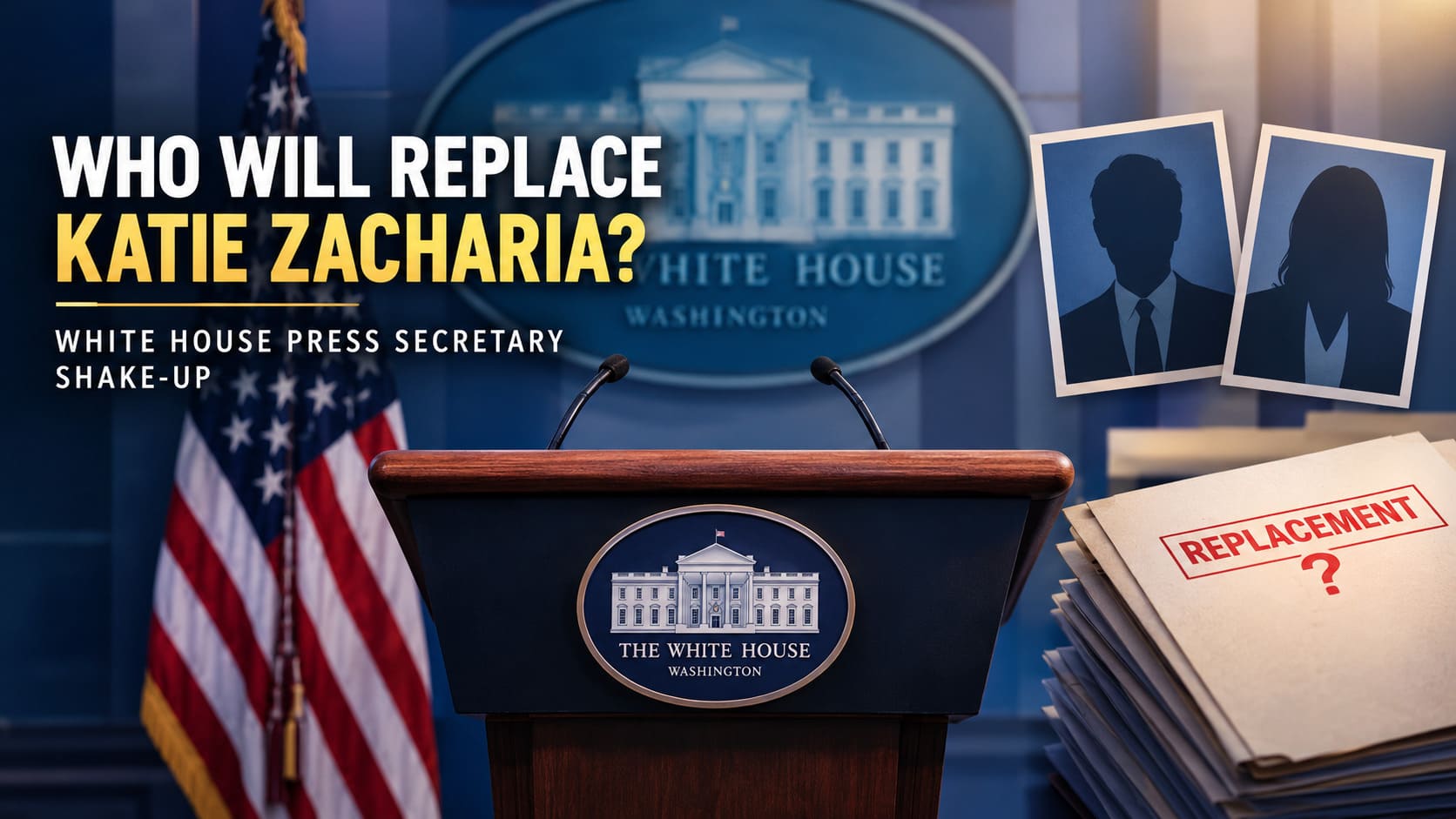
Katie Zacharia’s Five Days in the Spotlight
Zacharia’s appointment initially appeared to be a straightforward personnel decision. On October 9, 2026, Trump selected the 41-year-old conservative commentator and former communications adviser at Trump Media & Technology Group to replace Karoline Leavitt, who had reportedly stepped away from the position in August to focus on her family.
Trump presented Zacharia as a loyal supporter who understood his political movement. From the administration’s perspective, that alignment was presumably an advantage. A press secretary is expected to defend presidential decisions, challenge hostile coverage, and communicate the White House position without creating unnecessary distractions.
But loyalty and media experience are not interchangeable qualities.
Zacharia formally assumed her responsibilities on October 12. The following day, she appeared before reporters in the James S. Brady Press Briefing Room for what would become her only formal briefing.
The appearance reportedly lasted around 14 minutes. Rather than establishing an authoritative presence, Zacharia relied heavily on prepared notes, delivered a halting opening statement, and ended the session after taking questions from only three journalists.
A short briefing is not automatically a failed briefing. Presidents and their communications teams sometimes have legitimate reasons to limit a session. Yet the circumstances surrounding Zacharia’s appearance made the decision difficult to defend. The briefing was supposed to introduce a new spokesperson to the press corps. Instead, it gave journalists and political commentators an immediate reason to scrutinize her readiness for the job.
Reports that she had received insufficient preparation from White House staff only added to the impression that the transition had been rushed.
For a position that demands composure under pressure, the first impression matters enormously. Zacharia’s debut left little room for error during the days that followed.
Breaking News: President Trump’s new press secretary, Katie Zacharia, was fired after less than a week on the job, according to people familiar with the matter. https://t.co/IDuom8hTtW
— The New York Times (@nytimes) October 16, 2026
The Legal Credentials Controversy That Changed Everything
The decisive controversy centered on Zacharia’s professional background.
During the October 13 briefing, a reporter challenged descriptions of Zacharia as an attorney and asked about her qualifications to practice law in the United States. Her reported response, “When I was in China,” quickly attracted attention and prompted further questions about her legal credentials.
The distinction at the heart of the dispute was important. A law degree does not automatically confer a license to practice law in the United States. State bar admission requirements vary, and professional experience in another country does not, by itself, establish authorization to practice in an American jurisdiction.
According to the account of the controversy, Zacharia held a law degree from Pepperdine University School of Law but had not passed a U.S. bar examination or obtained an American license to practice law.
That did not necessarily mean she had no legal experience. Zacharia subsequently argued that she had worked in international transactional law while living in China under the relevant local credentials. She also maintained that her responsibilities in the White House were communications-related rather than legal.
Her explanation, however, did little to stop the controversy.
Zacharia appeared on Fox News and Newsmax on October 15 in an apparent effort to clarify her background. She acknowledged that she had failed the bar exam and defended her previous work experience. She also said she had not specifically corrected Trump’s description of her as an attorney because, in her account, the relevant questions had not been asked.
That defense raised a separate issue: what responsibility does a prospective senior government spokesperson have to correct a potentially misleading public description of their qualifications?
The answer matters because the press secretary is not simply another political commentator. The job involves speaking on behalf of the president and, by extension, the executive branch. A credibility problem involving the spokesperson can quickly become a credibility problem for the administration itself.
Why Trump’s Response Did Not End the Crisis
By October 16, the controversy had escalated beyond a disagreement over terminology.
Trump told reporters that the media had treated Zacharia unfairly. He also indicated that he had advised her to reconsider the position, citing concerns about her family. Senior officials subsequently confirmed that she was leaving the White House.
The president’s public defense was consistent with a familiar feature of his political style: a willingness to challenge media coverage even when the administration is dealing with a damaging story.
But defending a departing official and resolving the underlying controversy are two different tasks.
Trump’s comments did not erase the questions raised by Zacharia’s debut or the subsequent interviews. Nor did they answer the practical question of who would take responsibility for daily press briefings.
In my view, the most revealing part of this episode is not that a new appointee struggled in front of journalists. That happens in politics, and even experienced officials have difficult days. The real problem is that a personnel decision intended to strengthen the administration’s public messaging reportedly became a story about the appointee’s qualifications within days of her arrival.
That is precisely the sort of distraction a press secretary is supposed to prevent.
Who Could Become the Next White House Press Secretary?
With the position open, attention has shifted to potential successors. Scott Jennings and Margo Martin represent two different approaches to the appointment: bringing in an established media communicator or promoting a trusted insider.
| Potential Candidate | Main Advantage | Possible Challenge |
|---|---|---|
| Scott Jennings | Extensive experience in political commentary and televised debate | Would need to transition from commentator to official administration spokesperson |
| Margo Martin | Familiarity with Trump’s communications style and inner circle | Would face the challenge of handling sustained questioning from the White House press corps |
Scott Jennings: The Experienced Media Communicator
Jennings is a Republican strategist and a familiar face on CNN, where he regularly participates in political discussions and debates. His experience defending conservative positions in contentious media environments could make him an attractive candidate for an administration that wants a confident presence at the podium.
His strongest qualification is familiarity with the rhythms of political television. He understands how questions are framed, how disagreements develop, and how quickly a poorly phrased answer can dominate the news cycle.
That experience could help the White House respond more effectively to difficult questions.
However, appearing on a cable-news panel is not the same as speaking for the president. A commentator has considerably more freedom to express personal opinions, while a press secretary must remain aligned with official policy, even when the president’s position changes or the facts are still developing.
If Jennings were selected, the central test would be whether he could translate his debating skills into disciplined institutional communication.
Margo Martin: The Insider Who Knows Trump’s Operation
Martin offers a different set of advantages. As a trusted special assistant to Trump, she is familiar with the president’s communications preferences and the administration’s internal operations.
That familiarity could make the transition smoother. An insider may require less time to understand the White House’s priorities, approval processes, and rapid-response expectations.
Martin’s potential appointment would also signal that Trump prefers continuity over a high-profile external hire.
Still, proximity to the president does not automatically guarantee success at the briefing-room podium. The press secretary must be able to explain policy, address uncomfortable questions, and distinguish between a politically useful response and an answer that creates another controversy.
An internal candidate could offer the administration stability, but the position would still demand considerable experience and preparation.
At this stage, neither Jennings nor Martin should be described as the confirmed next White House press secretary. Their names represent potential directions for the administration rather than an announced decision.
Why the Next Appointment Matters Beyond the Briefing Room
The White House press secretary is often judged by the sharpness of their exchanges with journalists, but the job is more complicated than winning arguments in front of television cameras.
A successful spokesperson must coordinate with policy officials, understand the administration’s positions, prepare for predictable questions, and respond responsibly when unexpected developments emerge. The role also requires a difficult balance between defending the president and maintaining enough credibility that reporters and the public take official statements seriously.
Zacharia’s departure highlights the risks of prioritizing political loyalty without adequately demonstrating that a candidate can handle the practical demands of the job.
There is also a broader communications problem. In today’s media environment, a press secretary’s performance is distributed across cable television, social media, online commentary, and short video clips. A single awkward exchange can reach millions of people before the administration has prepared a response.
That reality makes preparation more important, not less.
The approaching midterm election period adds another layer of pressure. The White House will need to communicate its legislative priorities, defend controversial decisions, and respond to political attacks while competing for public attention. Leaving the press secretary position unsettled for an extended period could complicate those efforts.
Trump may believe that waiting will produce a stronger candidate. Given the circumstances, a careful selection process would be understandable. The danger is that an extended vacancy could make an already distracting personnel story appear more significant than it needs to be.
What Happens Next?
The immediate priority for the White House is to keep its communications operation functioning while the search continues. Senior staff can handle media inquiries and coordinate public messaging, but an interim arrangement is not a permanent substitute for a clearly established spokesperson.
The administration’s next decision will reveal what it believes went wrong.
If Trump chooses Jennings, the move could indicate a preference for someone accustomed to public confrontation and national television. If Martin receives the appointment, it could suggest that familiarity with the president and continuity within the administration are the overriding priorities.
A different candidate remains possible, particularly if the White House decides that neither of the prominent names under discussion fully meets its requirements.
Whatever the choice, the next press secretary will need more than political loyalty and a forceful speaking style. The position demands accurate preparation, professional credibility, and the ability to withstand relentless questioning without turning every briefing into a new controversy.
Clayface Movie 2026 Release Date, Theater Schedule, Showtimes, and News
Final Thoughts
Katie Zacharia’s reported five-day tenure is a reminder that the White House press secretary job is one of the most unforgiving communications roles in American politics. The person behind the podium must defend the president, represent the administration, and remain composed when journalists focus on uncomfortable details.
Trump’s decision to delay a permanent appointment may give the West Wing time to reconsider its options. It also leaves the administration dealing with a public personnel controversy at a moment when political messaging is especially important.
Scott Jennings and Margo Martin offer contrasting possibilities, but the more consequential question is what the president wants from his next spokesperson. Does he want a seasoned media performer who can handle confrontation, or a trusted insider who can maintain close control over the administration’s message?
The answer will help determine the direction of Trump’s communications strategy in the months ahead.
For now, the identity of the next permanent White House press secretary remains unconfirmed in the account available as of mid-October 2026. Until an official announcement arrives, the search itself will remain part of the political story.